
September 14, 2026 · Written by Team Oatey
Millet Milk Benefits: The Gut-Friendly Plant Milk That Won't Leave You Bloated
Last updated: August 2026. Reading time: about 6 minutes.
Quick answer: Millet milk is a dairy-free, lactose-free plant milk made from ancient Indian grains like ragi, bajra, and jowar. Its benefits include easy digestion, gut-friendly fibre, iron and magnesium, a low glycaemic response, and a far lighter environmental footprint than dairy or almond milk.
Key takeaways:
- Millet grains are naturally rich in fibre, iron, magnesium, and antioxidants [1][2].
- Millet milk is dairy-free and lactose-free, so it suits the 60% to 70% of Indian adults with lactose malabsorption [3][4].
- Millets are climate-resilient and need far less water than paddy rice, making millet milk a sustainable choice [5][6].
- Oatey combines millets with oats and offers a Kesar Badam Millet variant with an Indian flavour profile [7].
See also: Why Oatey Is the Best Millet Milk in India (2026) and Top 5 Plant-Based Milk Brands in India (2026).
What is millet milk?
Millet milk is a plant-based drink made by blending India's native millet grains, such as finger millet (ragi), pearl millet (bajra), and sorghum (jowar), with water, then fortifying it with nutrients. Millets have been cultivated in India for thousands of years, and the United Nations named 2023 the International Year of Millets on a proposal led by India [5].
Unlike imported almond or soy, millets grow locally and thrive in Indian conditions, which is part of what makes millet milk both a nutrition story and a sustainability story.
The real nutrition: grain vs milk
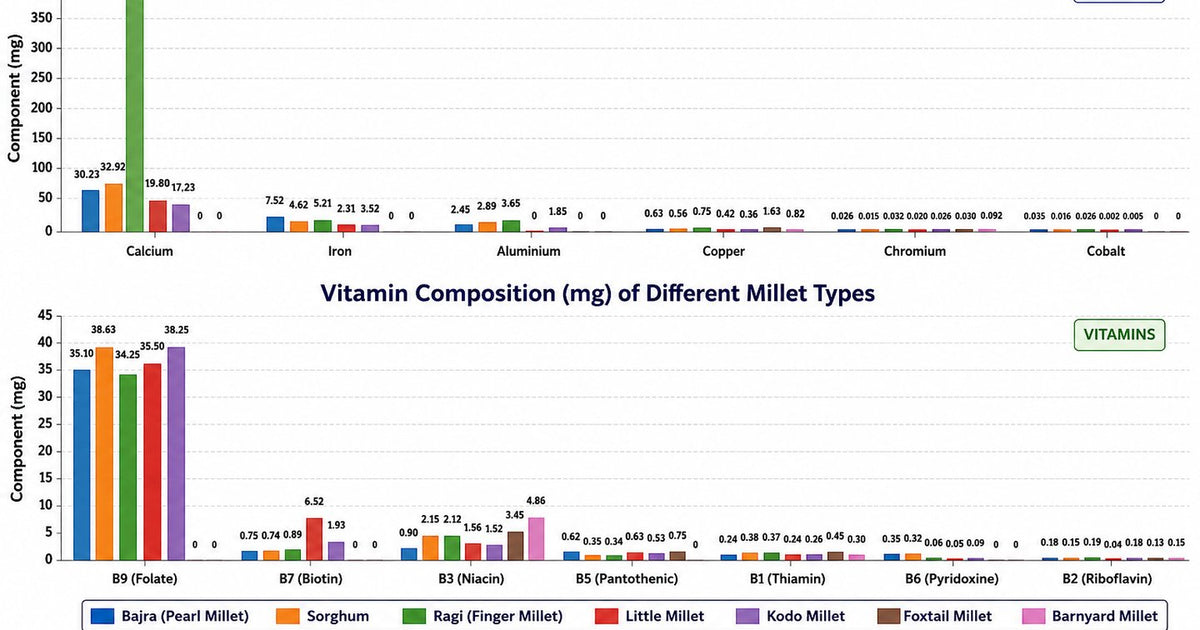
It is important to be honest about numbers. Millet grain is a nutritional powerhouse. Typical values per 100 g of dry grain are:
- Dietary fibre: about 8 to 12 g
- Protein: about 7 to 11 g
- Iron: about 3 to 9 mg, plus calcium, zinc, and magnesium [1][2]
Millet milk is a beverage that is mostly water, so a glass contains a fraction of those grain figures. What the drink delivers is easy-to-digest nutrition, gut-friendly fibre, and fortification with calcium and vitamins. For exact per-serving values, always check the pack label. Presenting dry-grain numbers as if they were the drink's numbers would be misleading, so we separate the two here.
6 evidence-based benefits of millet milk
1. Gentle on digestion, less bloating
Millet milk is 100% dairy-free and lactose-free. Because a large share of Indians cannot fully digest lactose, dairy often causes bloating, gas, and cramps [3][4]. Removing lactose removes that trigger, and the fibre in millets supports a healthy gut.
2. Gut-friendly fibre
Millets provide fibre and bioactive compounds such as polyphenols that act as fuel for beneficial gut bacteria and carry antioxidant activity [1][2].
3. Supports steady blood sugar
Millets have a lower glycaemic index than refined rice and wheat, and their magnesium content is linked in research to better blood-sugar regulation. This means millet-based foods may help support steady energy, though millet milk is a food, not a treatment for any condition [1][2].
4. Iron and magnesium
Millets are a good plant source of iron and magnesium, minerals that support energy metabolism and bone health, which matters in a country where iron deficiency is common [1][2].
5. Naturally gluten-free and allergen-friendly
Millets are gluten-free, and millet milk is free from dairy, lactose, and (in Oatey's case) nuts, making it suitable for households managing multiple food sensitivities [7].
6. Kinder to the planet
Millets are climate-resilient crops that grow in rain-fed, degraded soils and use far less water than paddy rice, with sustainability reviews and India's NITI Aayog promoting them as a low-water staple [5][6]. That makes millet milk a lighter-footprint choice than dairy or water-intensive almond.
Millet milk vs oat, almond, and soy
| Feature | Millet milk | Oat milk | Almond milk | Soy milk |
|---|---|---|---|---|
| Lactose-free | Yes | Yes | Yes | Yes |
| Gluten-free | Yes | Not always | Yes | Yes |
| Iron & magnesium | Good | Some | Low | Some |
| Water footprint | Low | Low | High | Moderate |
| Indian-grown grain | Yes | Mixed | Mostly imported | Mixed |
Note: values vary by brand and recipe. Check the pack label.
Why Oatey millet milk
Oatey is built around India's two smartest bases, oats and millets. Its Premium Millet Milk and Kesar Badam Millet Milk use Indian millets, are fortified with calcium and vitamins, and are dairy-free, gluten-free, lactose-free, hormone-free, and cholesterol-free, with no unnecessary preservatives [7]. The Kesar Badam variant adds a saffron and almond flavour no imported brand matches.
Don't stay bloaty, drink Oatey. Explore millet milk at www.oatey.in.
Frequently asked questions
Why choose millet milk over almond or oat? Millet milk is made from Indian-grown grains rich in iron and magnesium, is gentle on digestion, and has a low water footprint. Oat milk adds beta-glucan for heart health, which is why Oatey offers both [7].
Is millet milk good for people with diabetes? Millets have a lower glycaemic index than refined grains and provide magnesium, so millet-based foods may support steady blood sugar. Millet milk is a food, not a medical treatment, so consult your doctor for medical advice [1][2].
Will millet milk make me feel bloated? It should not. Millet milk is 100% dairy-free and lactose-free and contains gut-friendly fibre, which avoids the common lactose trigger for bloating [3][4].
What flavours does Oatey millet milk come in? Oatey offers a classic Premium Millet Milk and a Kesar Badam Millet Milk, both fortified with calcium and vitamins [7].
Can I use millet milk like regular milk? Yes. It has a naturally creamy consistency and works in coffee, cereal, smoothies, and Indian recipes.
The bottom line
Millet milk is one of the smartest dairy-free upgrades available in India: light on the gut, rich in minerals, low on water use, and rooted in Indian grains. Oatey does it justice with a fortified, preservative-free range.
Try it today at www.oatey.in.
References
- "An overview of millets, the nutri-cereals: nutritional profile, potential health benefits and sustainable cultivation."
- "Plant-based milk alternatives with a focus on millet milk for nutrition, health, and sustainability," Chemical and Biological Technologies in Agriculture, Springer.
- Tandon RK, et al., "Lactose intolerance in North and South Indians," American Journal of Clinical Nutrition.
- Lactose intolerance prevalence summary, drOracle medical reference.
- NITI Aayog, Promoting Millets in Diets: Best Practices across States and UTs of India, 2023.
- Observer Research Foundation, "Millets for climate resilience and food security in India."
- Oatey official product information.